
A newspaper publisher repeatedly prints biting commentary critical of the Governor. Incensed, the Governor instigates a grand jury investigation. The grand jury refuses to indict. Undeterred, the Governor’s ally – the Attorney General – files misdemeanor charges anyway and has the publisher jailed while he awaits trial.
At trial for libel, can the publisher defend himself by proving his statements were true?
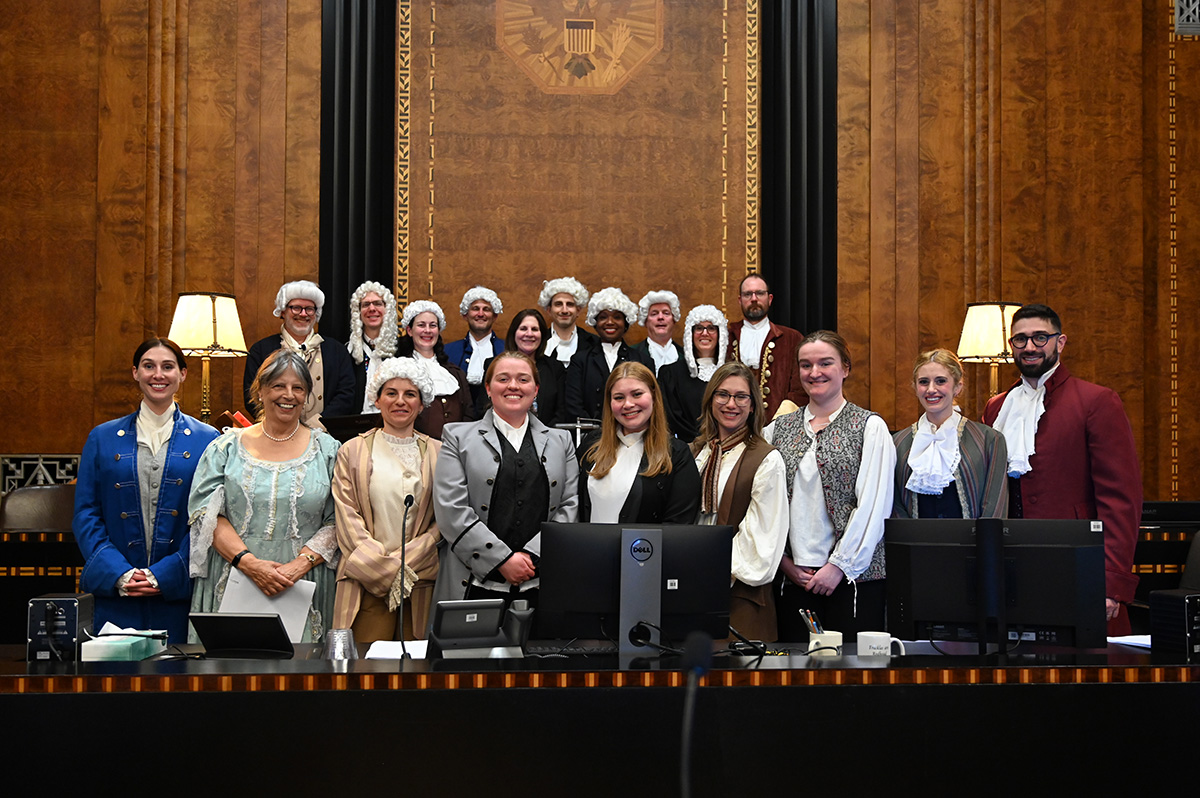
Costumed reenactors included Federal and State Judges, Assistant U.S. Attorneys, Albany Law Students, and journalists.
Under the law as it existed in British-ruled New York in 1735, the answer was no. Nevertheless, a jury acquitted the publisher, John Peter Zenger, following his Manhattan trial—an outcome that became a landmark moment in the history of press freedom.
Nearly 300 years later, on April 15, 2026, a packed crowd at the Ceremonial Courtroom in the James T. Foley Courthouse watched a riveting reenactment of this trial. Judges, lawyers, court staff, law students, and journalists – all in period costume – brought the proceedings to life, followed by a lively panel discussion on freedom of the press.
United States District Judge Mae A. D’Agostino directed the reenactment and served as its narrator. United States District Judge Anne M. Nardacci played a British judge. Appellate Division Justice Christina L. Ryba portrayed defense counsel Andrew Hamilton, while United States Magistrate Judge Daniel J. Stewart played Zenger himself. Times Union Editor Casey Seiler appeared as Zenger’s first attorney, and WNYC/Gothamist reporter Jimmy Vielkind played a British judge overseeing the trial.
Judge D’Agostino welcomed the public into the Courtroom to watch the reenactment and the panel discussion that followed. She said, “I want you to know that this courthouse belongs to all of you. You are always welcome here, and in all of our courthouses.”
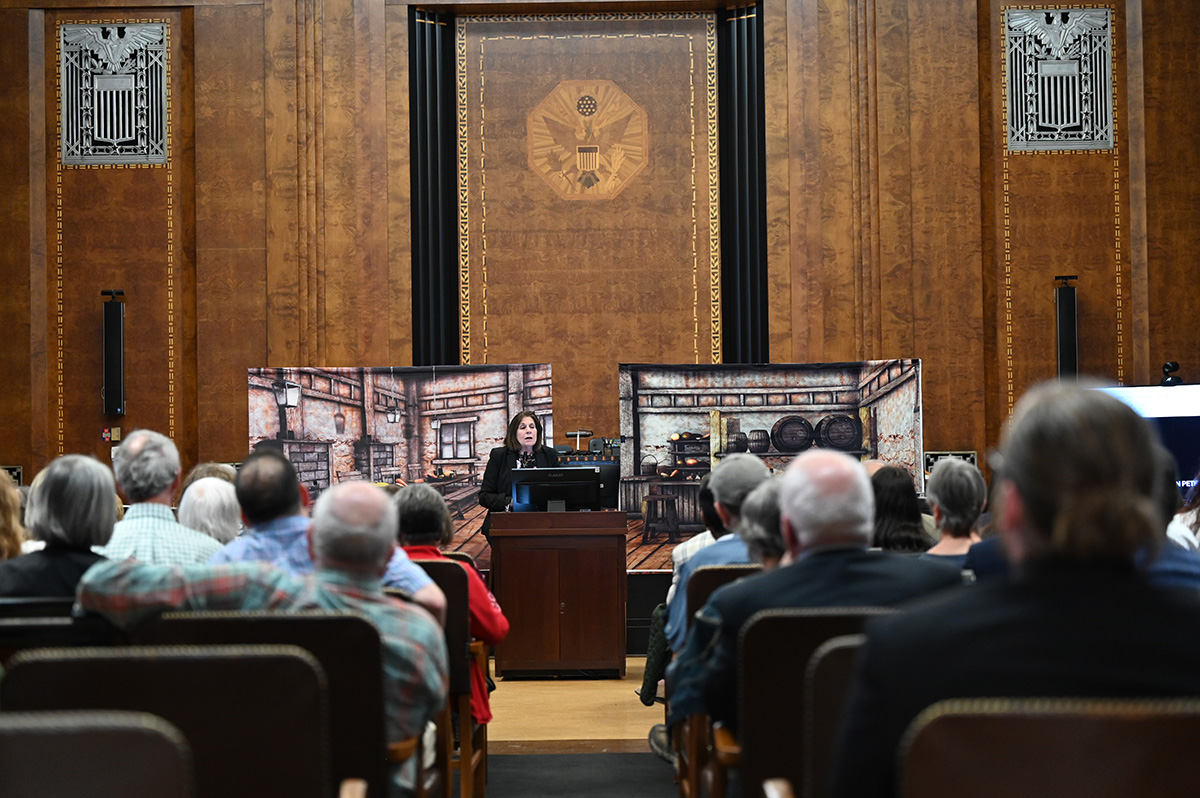
United States District Judge Mae A. D’Agostino addresses the audience to introduce the Zenger trial reenactment on April 15, 2026, in the Ceremonial Courtroom of the James T. Foley Courthouse in Albany.
Judge D’Agostino continued, “Our cases include matters of civil rights, discrimination, free speech, freedom of assembly, freedom of religion, and the right to bear arms. On the criminal side, we often handle cases involving drug distribution, conspiracy, identity theft, fraud, and crimes again children. Our cases are often impactful on the everyday lives of not only New Yorkers, but people across the nation. Tonight’s reenactment is part of our core mission – civic education. We service children from kindergarten to college and teach about the rule of law, the need for an independent judiciary, and civility.”
Holland & Knight Partner Christopher Riano led the panel discussion, which featured Seiler, Vielkind, and Henry Greenberg, a partner at Greenberg Traurig and Past President of the New York State Bar Association.
Greenberg discussed how the play accurately portrayed the law as of 1735 – truth was not a defense to a charge of libel. But the jury engaged in an act of nullification – they acquitted Zenger even though under the law as it then existed, they should have convicted. And even though Zenger was acquitted, he spent 9 months in jail awaiting trial. Greenberg noted that New York subsequently changed its law to make truth a defense to libel. “New York, more than any other state in the nation, for 200 years, has protected freedom of the press,” Greenberg said.
Greenberg noted that the Zenger case is still cited in courts to this day, and its themes still resonate. For instance, jury nullification can still occur. Zenger’s trial attorney, Andrew Hamilton, was the archetype of the lawyer as zealous advocate for a controversial cause, an “attorney for the damned,” Greenberg said.
Seiler discussed the importance of New York Times v. Sullivan, a Supreme Court case from 1964 that established that a plaintiff who is a public figure suing for defamation must prove that a defendant acted with “actual malice” when publishing false information – that is, the defendant either knew the statement was false or acted with reckless disregard to its falsity. Seiler said that the holdings of New York Times v. Sullivan remain important to this day and are in the background of conversations he has with his newspaper’s attorneys regarding the publication of important stories.
Following the event, Judge D’Agostino said, “The reviews from the public were amazing. Many people said they had never known of the trial itself; and even more said they wished the panel discussion could have gone on for many more hours.”
The trial re-enactment and panel discussion, as well as the catered reception that followed on the Courthouse’s first floor, were open to the public. The event benefitted from a preview by the Times Union, which also published a write-up and photo gallery from the event, with photos taken by Katherine Rogers.
Since 2017, including the Zenger trial, Judge D’Agostino has directed five trial reenactments, the others being: the NDNY trial of Susan B. Anthony; a First Amendment case involving Susan Russo, a Rochester-area teacher who was fired for refusing to recite the Pledge of Allegiance; the trial of Julius and Ethel Rosenberg; and the 1874 trial of Chy Lung.
Judge D’Agostino plans to take the Zenger reenactment on the road, bringing it to the federal courthouse in Syracuse this fall.
Photo credits: Katherine Rogers