
Eric Nordby, past FCBA President and a partner at the Porter Law Group, delivered the following remarks at the dedication of a federal courtroom in Binghamton to Senior United States District Judge Thomas J. McAvoy, on June 8, 2026.
Chief Judge Sannes, members of the Court, colleagues, and friends—and especially Judge McAvoy and Mrs. McAvoy—I know I can speak for everyone when I say it’s truly an honor for all of us to be here today.
Before I talk a little bit about Judge McAvoy, and what this day signifies, I want to briefly acknowledge people without whom Judge McAvoy, and many of us, might never have survived our time in this courthouse:
- First and foremost, Judge McAvoy’s family—his wife Sandy, and their four children, Chris, Kerry, Sandy and Dan, and their grandchildren, and the entire extended McAvoy family. Family matters, and none of us in this room could do what we do every day without family to support us.
- All the judges of the Northern District, past and present. None of us would have meaningful or gratifying careers without trusted colleagues—friends—to consult with, learn from, lean on, and occasionally commiserate with.
- Marlene Price, who has served Judge McAvoy and this Court with
extraordinary loyalty and professionalism for more than three decades. The real glue that has held Judge McAvoy’s Chambers together for a long, long time;
- Angela Topa, Judge McAvoy’s longtime courtroom deputy;
- Jim Connor, Judge McAvoy’s longest-serving law clerk, and many other law clerks, who are too many to name;
- And last and certainly not least, countless court employees, marshals, and security personnel.
I know Judge McAvoy would be the first to say that none of us reaches this point alone. None of us in this room could do this work without the support of family, colleagues, court staff, and lifelong friends.
I walked into this courthouse for the first time in 1993, as a young lawyer who had been practicing in Syracuse for only a year—in tax and finance of all areas. And like many people who enter a federal courthouse for the first time, I remember being awestruck.
This building—with its stone and steel and marble—felt immense. It felt serious. Important. And maybe more than a little intimidating.
And then I went upstairs to meet Judge McAvoy.
At the time, Judge McAvoy had recently become the Chief Judge of the Northern District, which entitled His Honor to a third law clerk. Jim Connor and Ken Gage were already here, and somehow Judge McAvoy took a chance on me, as he did with scores of law clerks over the years, some of whom are here today.
It changed my life and my career. And I know I’m not alone in saying that. If not for that experience, I wouldn’t BE a litigator today—and I mean no offense to any tax lawyers in the room.
For one remarkable year, I had the privilege of serving in these Chambers at 15 Henry Street. Every day, I drove down from Syracuse with Larry Baerman, then the Clerk of the Northern District, Ken Gage, and John Domurad (who would eventually become Clerk of the Court himself).
Looking back now, it feels like it was less a commute than a rolling seminar on the Northern District of New York: its people, its history, its traditions, and its deep sense of professionalism and public service.
And at the center of all of it was Judge McAvoy.
Anyone who practices before His Honor knows exactly what I mean when I say this: Judge McAvoy always has his sleeves rolled up—literally and figuratively.
He comes prepared.
So you had better come prepared, too.
Because Judge McAvoy is always ready.
He knows the record. He knows the law. He knows when a lawyer is dancing around the answer. But he also knows how to put lawyers—and litigants—at ease when they need it most.
That combination is rarer than people think.
A federal judge must project authority, sure. But truly great judges also project humanity.
Judge McAvoy does both.
And he does it in a way that makes everyone feel welcome in his courtroom.
Over the years, many of us have come to know Judge McAvoy not only in court, but in chambers, at bar events, around the poker table, and in his home with Sandy and their family. Whether His Honor is winning or losing at cards—and I won’t speculate publicly which occurs more often—he carries himself with the same qualities that continue to define him as a judge and a person: Humility, good humor, competitiveness, grace, and respect for the people around him.
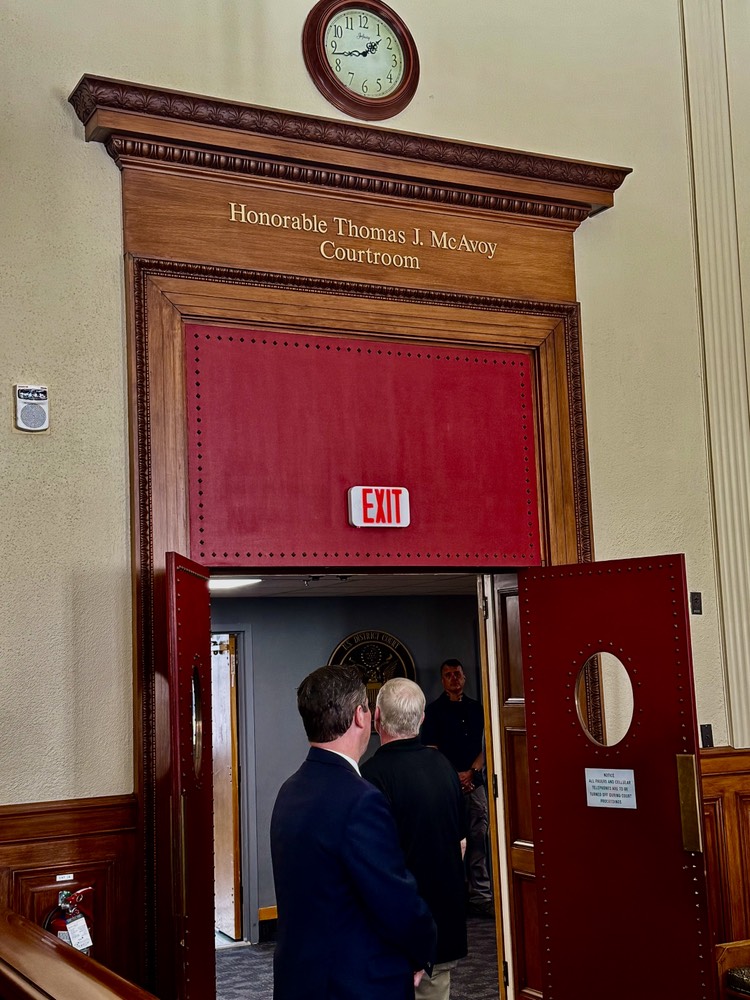
Today, we dedicate a courtroom in his honor.
And that feels exactly right.
Because courthouses, and courtrooms, matter.
This is where ordinary people come during extraordinary moments in their lives. Here they find themselves hopeful, frightened, angry, grieving, sometimes vindicated, and sometimes defeated. But what they remember—long after they forget the legal arguments—is whether they felt heard. Whether they believed the process was fair. Whether the people entrusted with power treated them with dignity.
For decades, Judge McAvoy has represented that dignity to the people of the Northern District of New York.
This courthouse has served generations already, and it will continue to do so long into the future. New lawyers, litigants, and citizens will enter this courtroom for the first time, perhaps feeling the same sense of awe and responsibility that I felt when I first walked through these doors in 1993.
And when they see Judge McAvoy’s name on this courtroom, they won’t know every case he decided, every title he held, or every contribution he made to this Court.
But they will know something important: he is a person whose life and work matter enough that this institution has chosen to honor him in a lasting way.
I was curious to know how many individuals have served as an Article III judge in this District since it was formed in 1814—more than 200 years ago—and I was shocked to learn the number: only 30 men and women have had the privilege of serving this Court as a district court judge.
Honors like this are exceedingly rare in the federal judiciary—a judge’s name permanently associated with a courtroom where justice will continue to be administered for generations to come.
I hope Marlene and Judge McAvoy aren’t mad at me for sharing this, but when Judge McAvoy learned this courtroom would be dedicated in his honor, he smiled and simply asked: “Why?”
And honestly, that may tell us as much about Judge McAvoy as anything I could say today.
He’s unassuming. He neither expects nor seeks accolades. He’s simply not someone who looks for recognition.
But I’ll try to answer the question “why”—and I know everyone else in this room already knows the answer.
Because Judge McAvoy continues to represent the very best of this Court and this profession.
He has strengthened this institution.
He has advanced careers.
He has influenced lives for the better.
And he has served this community with distinction.
Your Honor, on behalf of one grateful former law clerk—and I know I can speak for every person in this room—thank you.
Thank you for your mentorship.
Thank you for your example.
Thank you for your friendship.
And thank you for all that you have done, and continue to do, for this Court, this community, and our Northern District family. Congratulations, Your Honor.