
Interviewed By Janelle A. Pelli
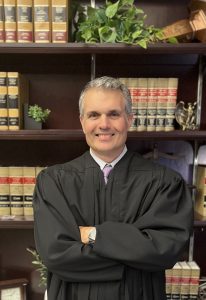 Paul Evangelista is the NDNY’s newest Magistrate Judge, having taken the bench in January 2025. He discussed his career in private practice and at the Office of the Federal Public Defender in Albany, advice for criminal defense attorneys conducting trials, and his transition to the bench.
1. First, can you tell us about yourself and your path to the bench?
I grew up in the Capital District. After graduating from Bethlehem High School, I earned a Bachelor of Arts in Political Science from the University of Rhode Island. I came back to the area to attend Albany Law School. After law school, I worked at a small firm for about five years. I was exposed to a variety of cases and law at the firm. My partners allowed me to do Criminal Justice Act (CJA) work, and I started handling many federal criminal cases. I enjoyed practicing in federal court. So, when the Office of the Federal Public Defender came into town, I eventually applied for a job with that office and never left.
I spent 12 years as an Assistant Public Defender, and then another 12 years as the First Assistant. In a management role, I had the privilege of gaining further insights into the federal court system and the individuals who dedicated their lives to serving there. I had always envisioned concluding my career at the Defender’s Office. However, when the opportunity arose to apply for the Magistrate Judge position, I believed it would be an excellent opportunity to continue working in the federal system while remaining in the area and experiencing a change in my daily routine.
2. What drew you to work in the Office of the Federal Public Defender for the Northern District of New York (NDNY)?
During the first four years of my career I took on a lot of CJA panel work and pro bono 1983 cases. In 1998, I attended a CJA training event in Boston, Massachusetts with another local criminal defense attorney. It was the first time I was exposed to the Federal Public Defender organization. We left the training and agreed that if a Defender’s Office ever opened in the NDNY we would apply. As fate would have it, in 1999, the NDNY opened a Federal Defender’s Office. He applied and became an assistant defender, while I chose not to apply. Fortunately, by 2000, the office was growing, and I applied for an open position, was selected, and never left. I thoroughly enjoyed the relationships we built at the Defender’s Office. I never regretted making that move. The work was incredibly fulfilling, and the camaraderie was truly special.
3. Your NDNY biography says you’ve successfully represented defendants in over 1,800 criminal cases. That is an impressive volume of cases. With that vast experience in mind, what did you learn from being a Public Defender?
My people skills were sharpened at the Defender’s Office. As a defense attorney, I found myself assisting individuals during some of the most challenging moments of their lives. My ability to empathize with them and guide them through the complexities of the federal system proved to be a significant asset in helping them navigate these difficult circumstances. Once I became the First Assistant, I was managing staff, handling a full caseload, and assuming administrative duties, so it was very important to be organized and efficient with my time. My role in the Defender’s Office helped me hone these skills.
4. What tips do you have for representing criminal defendants before a jury?
The jury sees everything you do with your client. If you aren’t engaged with your client, the jury won’t be either. I liked to show the jury through my body language that I liked my client, and they should too. It’s also important to remember that the jury hasn’t spent the past six months immersed in the facts like you have when you’re preparing for a trial. You must establish a solid foundation for your case, even the most fundamental aspects. I tried a case involving the theory that a child’s potential environmental exposure to certain drugs caused his death, not the acts of the defendant. After the case I had a juror ask what cocaine looked like, obviously an important fact for me to present and not assume it was well known. It’s easy to take for granted what you know about your case and the issues or items involved in it. Try to avoid that. Talk about your case with anyone who will listen, bounce your theories and themes off friends and family – they’re free mock jurors.
5. Now that you are a Magistrate Judge, what do you find to be most rewarding about sitting on the bench?
The role is better than I imagined. It’s an incredible position, and has been both invigorating and challenging. I like the variety of the work. The civil side is relatively new for me. After 30 years as an attorney mainly practicing in only a couple areas of the law, it’s invigorating to learn something new almost every day.
6. What do you find to be most difficult as Magistrate Judge?
It’s a tremendous amount of work. The Defender’s Office is very busy, but now because I am public facing, I feel as though I have an obligation to be here and be accessible all the time. It’s challenging but also so rewarding to be presented with such a variety of issues.
7. Drawing from your experience both trying cases and sitting on the bench, what do you think makes an effective trial attorney?
It’s 99% preparation. It’s also important to be yourself in the courtroom. It’s good to see how others do it, but be yourself. The jury will pick up on the genuineness of your presentation. If you’re passionate and honest, the jury will see that. It also helps to talk to more senior litigators and network. I’ve always found most local attorneys to be collegial and friendly, and great to talk to about their experiences.
8. Do you have any tips for attorneys practicing before you?
Be professional. Treat your adversary with respect. It is important to be civil. It doesn’t help you in my court to take swipes at your adversary. A strong, well-prepared argument and papers are very important.
9. Do you have any words of wisdom to share with our First Decade Committee members who are just starting their careers?
You build your reputation in the first decade. It’s hard to build and easy to ruin. Have integrity and be honest and compassionate. Also, do pro bono work for the Northern District of New York, and join your federal and county bar associations. Both are great ways to get recognized and network.
10. Speaking of bar associations, what role has the upstate New York legal community, including the NDNY FCBA, had in your career?
I was around when Judge Scullin championed the NDNY FCBA. It’s a great way to network and see the judges at events. Now that I’m a judge, I try to attend as many events as I can. Get involved with the committees. I was co-chair of the criminal practice committee. There are so many opportunities to build your legal reputations through the bar association. Some of the most well-respected attorneys in the district are in bar associations and many hold leadership positions.
11. What do you enjoy outside of work?
Coaching my kids in their sports was incredible. Now that they are out of the house I have a lot more time. I love to get outside and ride or ski, and my wife and I enjoy watching Jeopardy together.