
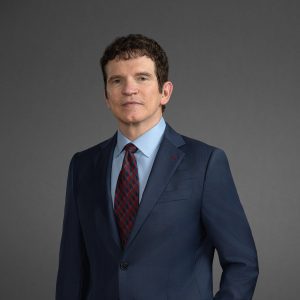
 Robert Alessi, a partner in DLA Piper’s New York City office, has deep NDNY roots. Born and raised in Oneida County, Bob attended both college and law school in Albany, raised his children in the Town of Bethlehem, and regularly practices in the Northern District of New York.
Bob recently achieved national prominence during the 2025 retrial of Karen Read, a Massachusetts woman who was charged with the murder of her boyfriend, a Boston Police Officer. Ms. Read had enormous grassroots and social media support. Her first trial, in 2024, ended in a hung jury in Norfolk Superior Court. Bob joined Ms. Read’s defense team pro bono for the two and a half month retrial, which was televised from beginning to end. On June 18, 2025, the jury acquitted Ms. Read of murder and manslaughter charges.
Bob discussed his pharmacological training and how it’s shaped his legal career, his involvement in the Read case, and what he’s doing now.
1. Let’s start with your education. You obtained your bachelor’s of science degree from the Albany College of Pharmacy and Health Sciences, and you are a licensed pharmacist. How did you end up going to pharmacy school?
I ended up going to pharmacy school because my favorite subject in high school was chemistry. Once my high school guidance counselor learned of my interest in chemistry, he simply directed me to the “Pharmacist” folder in his careers cabinet. I read the Pharmacist folder, told him pharmacy looked good to me, and after this interaction I entered pharmacy school in Albany. It was that straightforward and fairly uneventful.
2. For how long did you practice as a pharmacist?
I went straight to law school upon graduating from pharmacy school. I practiced as a pharmacist for two years, starting the summer after my first year of law school. I then worked Sundays as a pharmacist for two years after starting my practice of law. I really liked the pharmacy profession but realized working seven days a week in law and pharmacy was not a good or sustainable career plan.
3. What elements of your pharmacological training have helped you as a lawyer?
Really all elements. Foremost, was the perspective of striving to help others that pharmacy training engenders. Next was the steely focus on being careful, for instance, not making a mistake such as giving the wrong medication or wrong dose of a medication to a patient. After those two, the rigorous STEM subject matter syllabus such as every chemistry known to man (it seemed), physics, calculus, microbiology, and statistics really helped me apply scientific analytical skills in the legal realm. My practice often is STEM-centric or otherwise technical. So all the course work in pharmacy helped me understand the scientific principles I use daily in the practice of law. But I was also a philosophy minor as a result of the influence of my paternal grandfather, who was well read in that subject. Philosophy courses taught me critical thinking, logic, and (hopefully) how to write cogently and persuasively. I leave it to the judges whether what I was taught in philosophy courses makes it into briefs and other documents I write. Lastly, pharmacy school taught me educational discipline, including having the humility to accept that I may need to read something over and over again, do independent technical research, and ask for help in understanding concepts rather than glossing over analytical shortcomings and hoping they don’t come to roost. The pharmacy school curriculum was quite challenging, but I believe it prepared me well structurally and substantively for the technical and overall practice of law.
4. You’ve practiced in a number of areas over the years. What are your main practice areas today?
My “main practice area” today is the defense of mass torts and environmental harm — trial and appellate work. But in any given six-month period, that can change and has changed to areas such as energy regulatory, bank litigation, white collar crime, and project development such as major sports stadiums for professional football, soccer, and basketball.
5. How much of your work is for clients in Upstate and Central New York?
It varies, but on average it is between twenty-five and thirty-five percent of my work.
6. How did you get involved in the Karen Read case?
One of the co-counsels on the case, David Yannetti, reached out to me. There were many attorneys nationwide seeking to join the defense team for the retrial, so there was a bit of an audition and due-diligence process. After meeting with the existing defense counsel, Ms. Read, and Ms. Read’s family, I was asked to join the defense team.
7. A criminal trial, involving the death of an off-duty police officer, is not a typical pro bono case for a BigLaw firm. How did the management of DLA Piper react to your wanting to get involved in this case?
You are correct, this is definitely not the typical pro bono case for a BigLaw firm, especially at the trial level. The reaction of management of DLA Piper was quite positive. I had shown them information supporting the proposition that Ms. Read could be innocent. After further diligence, management readily agreed to my involvement in the case. I am very proud of the management of my firm for allowing me to take on the case and do what was necessary to achieve the objective of our client. In the end, our representation here was a bit of a leap of faith by firm management, even after assiduous due diligence.
8. Did this case end up being a full-time job and for how long?
It ended up being substantially a full-time job from December of 2024 until June 18, 2025. However, I put in extra hours to keep up with my other cases at DLA Piper. In effect, I had just about two full-time jobs during that time period.
9. I assume you had not previously practiced in Norfolk Superior Court, and were not familiar with Massachusetts criminal law. What did you do to get up to speed?
That assumption is correct. I read several Massachusetts-based treatises and other publications such as the Massachusetts Guide to Evidence (2025). I also read numerous leading cases. However, please recall that I had David Yannetti as one of my co-counsels and brainstormed with him often. I know of no better “blue collar” criminal defense attorney in Massachusetts than David.
10. Over your career you’ve had a lot of experience dealing with experts, but mainly in civil matters. How did you prepare yourself to cross-examine the District Attorney’s experts in this criminal case?
I did what I usually do in preparing for a case laden with experts. That is, I read an enormous amount of background materials on the various subjects and sub-subjects and brainstormed with and was taught by leading experts in the respective technical fields.
11. How did this case’s enormous grassroots and social media following impact your approach to trial?
I’ll start out with what out did not impact my approach to trial. It did not affect my trial or other courtroom style at all – for example, oral arguments on the many pre-trial (Daubert) and trial motions (mistrial). I tried the case the way I always try cases. Yet the enormous grassroots and social media following did impact my approach to the trial in other ways. Foremost, I accessed social media continuously during pre-trial and trial as a sort of ongoing and enlarged focus group. The following also motivated me; I wanted to achieve our client’s objectives most of all, yet I also wanted to do my best for the people who were so invested in the outcome of the trial. So many people told me before and during the trial that Ms. Read could be them, their daughter, their sister, their mother, or their close friend.
12. Having been involved in this high-profile criminal trial, was it hard for you to go back to civil practice?
Yes, surprisingly, it was hard to go back to my civil practice at first. The important civil practice is more behind-the-scenes than the constant intensity, exhilaration and press coverage, which can be a bit “addictive,” that I experienced for six months in the Read pre-trial and trial matters. However, that transition difficulty faded in due time, especially as my civil practice returned to its intense pace.
13. What about the criminal trial do you keep in mind for your civil practice?
How fortunate we are in civil practice to have sufficient time to receive litigation documents such as expert trial PowerPoints and demonstratives and prepare to address them. During the Read trial, I often received these types of trial documents at 10 p.m. the night before the prosecution expert would be testifying at trial. I also keep in mind the significant responsibilities we have as lawyers to comport ourselves properly at all times. In the Read case, I was video-recorded inside and outside the courtroom almost daily for almost six months.
14. Without getting into specifics, have you gotten new clients, or more business or more client inquiries, as a result of your work in the Read retrial?
Yes, I have had robust activity in all those categories. I am grateful for the interest. I’ve had to make some hard decisions on which new matters to take on, though. I hope I have made the right decisions in this regard. It is really hard to have to decline legal representation of a person or company in need.
15. Would you get involved in another matter like the Read case, pro bono?
Yes, but it would probably need to be a good bit down the road. I am still catching up on my regular practice of law.
16. Always our last question: what do you like to do in your spare time?
I exercise often (I am a bit of a gym rat), including weight training and sparring in boxing gyms (I have been boxing since I was 9 years old); I tag along with family members on their adventures and try to convince them to join me in mine; I get together with friends, especially close ones, socially as much as possible just to talk and laugh; and I love to read novels.